
INDUSTRY USE CASE
Food production industry growth engine: hungry for cash flow?
I heard this joke the other day –
’Our fruit and vegetable business recently went into liquidation. We now sell smoothies.’ 🤣
Jokes aside, the European food production industry is giant with many sub-industries, e.g. agriculture, livestock, fisheries, and food & beverage – in addition to related supply chain industries.
Food production is a huge part of the EU economy. Just look at food & beverage processing to get an idea: 291K businesses (14.1% of the EU’s manufacturing companies), 4.6 million employees (15.5% of EU employment), and 227 billion added value (12.1% of EU added value) [1].
Meanwhile, the B2C food market in Europe is expected to grow annually by 5.41% CAGR 2024-2029) [2]. Behind that growth we’d expect the B2B trade to grow as well, thus ensuring the food products are available for consumers.
Let’s look at even more interesting facts about European food production and then propose how payment terms can help food production businesses find success, i.e. survive, grow, and thrive.
Agriculture
What is the value of crop output in 2023?
The value of crop output as a percent of the EU’s total looks like this for select countries (and not all that surprising considering limitations imposed by the geographical size of the countries) [3]:
- France – 19.5%
- Italy – 13.7%
- Germany –13.3%
- Spain – 13.1%
- the Netherlands – 6.1%
- Belgium – 1.8%
How is farmland divided up?
58.2% of EU farmland is considered crop specialist. 21.7% as livestock specialist. 19.3% as mixed farming [1].
Which crops rule the roost? As of 2022, common wheat was the top crop (126+ million tonnes), followed by sugar beet (103+), and fresh vegetables (60).
What about organic farmland? By 2030, minimally 25% of the EU’s agricultural land should be farmed using organic processes [4]. As of 2021 the number stood at 9.9% and increased to 10.4% in 2022. Perhaps a slower start than expected, but “conversion” to organic farming is growing and we’re confident the EU’s farmers will meet the target. This will naturally create a larger and larger market for the trade of products needed to farm organically, e.g. feed, seeds and propagating materials, live or unprocessed agriculture products, and processed agriculture products to be used as food.
What is the EU’s approach to organic farming? Explore the EU’s policy, rules, organic certifications, support and criteria for organic farming.
How can food production be more sustainable? Check out pages 8-12 in the Farm to Fork strategy.
Are prices up or down?
6% – that’s the average percent of agricultural price decline in the EU for Q1 of 2024 YoY [5]. Cereals are down 28%. Tomatoes are down 33%. Output prices are down in all EU countries except in Greece, Spain, Malta, Cyprus and Portugal. Five countries showing the largest declines in agricultural output prices are Hungary, Bulgaria, Romania, Slovakia, and the Czech Republic.
Input prices are down in all countries except Portugal. The five countries with the largest declines in input prices are Croatia, Hungary, the Netherlands, Ireland, and Lithuania [5].
Is the fertiliser market growing?
No, it’s shrinking. The use of mineral fertilisers was down 10% in 2022 YoY, and down 15.9% from its peak in 2017 [6]. Businesses on this side of the food production industry were affected by sharp price jumps after the Russian invasion of Ukraine and subsequent sanctions [7].
Trade in the food production industry
B2B trade is our bread and butter, So, let’s look at some figures regarding food production trade, both intra-EU and extra-EU.
The EU’s total trade in agricultural products, fisheries, and food & beverage [1]:
- 68.6% between EU member states
- 31.4% between an EU Member State and non-EU country.
Exporting is big business whether intra-EU or extra-EU (in billions) [1]:
- Food & beverage products: €181 intra-EU vs. €116 extra-EU
- Animals & animal products: €125.6 / €47.7
- Crops & crop products: €119 / €47.3
- Vegetable or animal oils and fat: €31.7 / €10.8
Could some of these exporters find a way to offer deferred payment terms to their customers? Hmmm…
What about payments in the food processing industries?
‘Among the various industries in our survey, the agri-food sector across the region is especially worried about the impact of domestic economic conditions on business prospects’ [8]. However, in terms of improving customer payment behaviour (e.g. late payments), the agri-good sector is the most optimistic [8]. And, what about selling on credit? Well, the agri-food sector is the most likely to sell on credit, according to Atradius [8].
B2B BNPL and deferred payment terms for European food production
Ready to quack up? Well, it’s time for another classic joke:
A duck walks into a bar, orders a beer, and tells the bartender, ‘Put it on my bill.’
Guess what? We know ducks aren’t the only ones who want to pay later! Marketplaces and merchants trading in the food production sector find numerous benefits when they offer AREA42’s TermsTech, which delivers B2B BNPL deferred payment terms.
For their B2B buyers:
- A chance to pay later with convenient and secure payment terms
- Rapid eligibility assessment
For the marketplaces and merchants:
- Mitigating risk because TermsTech takes on the burden of non-payment and/or fraud
- Reducing DSO and improving cash flow
- Increasing sales
- Improving cash flow
- Higher conversion rates and customer satisfaction levels
- Solidifying customer lifetime value
It’s time to talk to TermsTech, isn’t it? Get in touch with us to discover how TermsTech can improve your business.
Sources
1 – EU’s ’Key figures on the European food chain – 2023 edition’
2 – Statista’s Food – Europe
3 – Eurostat’s DIY agricultural factsheet
4 – EU’s Farm and Fork Strategy
5 – Eurostat’s Agricultural prices decrease in first quarter of 2024
6 – Eurostat’s ‘Use of fertilisers in EU agriculture down 10% in 2022’
7 – EU’s ‘Safeguarding food security and reinforcing the resilience of food systems’
8 – Atradius’ ‘Payment Practices Barometer 2024 – B2B payment practices trends – Western Europe’ (since unpublished)
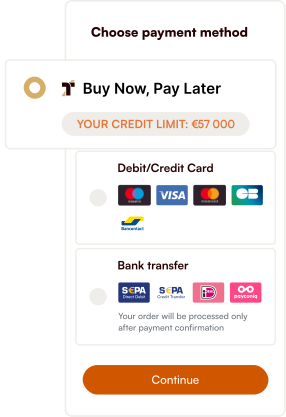
Here’s how it works for businesses in the food production industry
Integrate TermsTech’s payment terms into your online checkout. This enables you to offer trade credit on tap to online buyers. If your buyers choose to pay with payment terms, they defer payment of their purchase up to 120 days.
But, food production industry sellers receive payment upon proof of delivery. Buyers subsequently pay us back in line with their chosen terms. This is a win-win for both and helps buyers and sellers manage their cash flow more sustainably.
Our tailor-made payment terms solution caters to all your needs. The result? You do not have to worry about credit rating checks, financing, fraud protection, risk management, payments, or even debt collection.
5 reasons to choose TermsTech as your payment terms provider

Enhance customer experience
B2B customers love to pay for goods with credit. Offer TermsTech’s payment terms at your checkout and watch your conversion rates increase while you attract new customers. Flexible. Fast. Easy to use.

Larger transaction sizes = grow revenue
Without providing payment terms, only a few B2B customers would be brave enough to make large transactions. Our credit limit strategy of up to EUR 200k makes the buying decision easier.

Fast and consistent cash flow
Your cash flow and working capital are key to a successful business. We pay you up front and the buyer pays us back via payment terms up to 120 days. It’s a win-win for you and your customers.

Fine-tuned credit check
Give your business the reputation it deserves. With our in-house-developed eligibility assessment tool, you can rest assured that we extend payment terms only to those with a good credit rating. Not only is our process lightning fast, it takes the pressure off of you to run your own checks.

Risk-free terms
Any non-payments? That’s not your problem anymore! Our Buy Now, Pay Later solution is completely risk-free for you. Any payment defaults due to fraud or non-payment are on us. This way you can reduce your risk while focusing on what you do best. TermsTech helps you to build your business wisely and safely.
Contact us

Hi, I’m Wouter!
I’d love to discuss how we can help your operation with our working capital solutions. I’m looking forward to meeting you and answering all of your questions about AREA42.