

SMEs rely on short-term financing to conduct their businesses and to ensure they have the working capital they need. Factoring has long been the B2B industry standard for short-term financing, especially in Europe, which accounts for 65% of the global factoring market.
Factoring (aka invoice factoring and receivables financing) solves a financial problem that small and medium-sized companies tend to face: it reduces or even eliminates the laborious challenge of getting a bank loan to provide needed working capital.
But is factoring the only solution? And, if not, is it the best? Or just the traditional solution that companies are used to using?
Alternative to factoring: how does true B2B BNPL work?
AREA42’s deferred payment terms solution, TermsTech, is a true BNPL solution (Buy Now, Pay Later for business to business transactions).
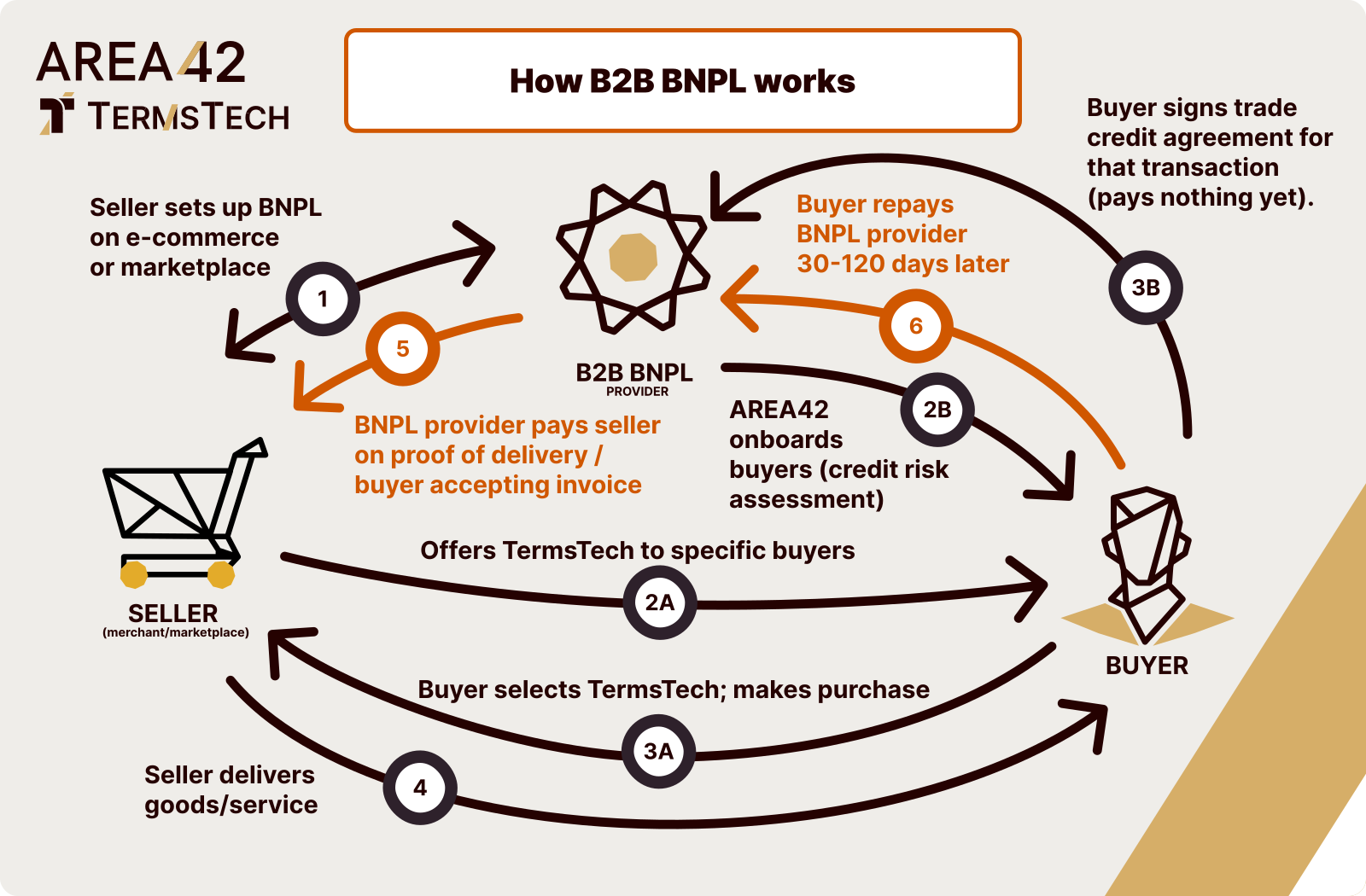
Let’s describe the true BNPL process and players through 6 straightforward steps:
- The buyer repays TermsTech in 30, 60, 90, or 120 days later according to their agreement.
- The seller (or marketplace) agrees to offer TermsTech and sets it up on their e-commerce site (or marketplace); and/or, chooses to use it for offline purchases with TermsTech’s self-service module.
- A seller offers TermsTech as payment method to specific buyers, so that AREA42 can onboard these buyers including credit risk assessment.
- After a buyer fills its basket, the buyer selects a payment method, i.e., TermsTech. By selecting TermsTech, the buyer signs a trade credit agreement for the transaction at hand, but the buyer pays nothing yet.
- The seller delivers the goods to the buyer without taking any credit risk.
- TermsTech pays the seller on proof of delivery and acceptance of invoice by the buyer.
True BNPL is a win-win
This is a win-win for both sellers and buyers. Why?
- The seller gets paid as soon as the seller invoices while the buyer defers payment for as long as needed. [Read more on that here.]
- Both improve their working capital position: the seller increases sales without taking on credit risk nor taking out bank loans while the buyer gets the goods it needs without using its cash or putting up any collateral up front.
How is true B2B BNPL different from invoice factoring?
Ok, that process makes sense, but how is true BNPL different from the factoring process that companies are used to?
Your buyers’ credit limits; not yours!
With factoring credit limits are based, a.o., on your (the seller’s) creditworthiness. However, TermsTech does not restrict the credit limit of your buyers to your creditworthiness.
Instead, TermsTech does a robust analysis of each buyers’ creditworthiness and this determines their credit limits.
Why does using buyers’ credit limit matter in practice?
AREA42 doesn’t take credit risk on the seller via TermsTech as AREA42 doesn’t have a credit agreement with nor expects a repayment from the seller. AREA42 does take credit risk on buyers. AREA42 limits this risk per buyer, not per seller.
So, it happens all the time that a seller with a limit of 100K, has buyers with much higher limits. This means that AREA42 would finance transactions up to 1.5M if the seller has, e.g., 10 buyers, each with a limit of 150K.
100% payment vs. 70-90%
Upon selling an invoice to a factoring company, the merchant usually receives between 70-90% of the value of that invoice. Once the buyer pays the factoring company, then the merchant receives the remainder.
However, with TermsTech’s true BNPL approach, the merchant receives 100% of the sale upon proof of delivery minus the cost of the trade credit agreement. TermsTech takes on the risk while the buyer then has between 30-120 days to pay.
This accelerates and smooths out the payment collection for the seller. Simply put, upon completing their obligation payment happens. That means the full value of the goods goes into the seller’s bank account as quickly as possible, increasing cash flow.
Transaction-based financing
Factoring is traditionally portfolio-based. That means a company agrees to sell its entire ledger of receivables to the factoring company. Sometimes you’ll hear this called a whole turnover agreement. Doing so helps spread the risk over the average of the receivables rather than strictly based on each individual transaction. Additionally, factoring agreements often lock a company in for years.
True BNPL however is transaction-based so TermsTech does not require a seller to engage in a whole turnover agreement. Instead, the seller offers the BNPL option to its buyers, and the buyers who qualify can choose to use TermsTech for purchases on a transaction-by-transaction basis.
Your buyers opt in as needed. They don’t have an obligation to use BNPL for each transaction giving them maximum flexibility when purchasing.
True BNPL is cheaper than cash discounts for early payments
We were recently at an expo talking to a representative of a potential TermsTech customer who was very proud of the discounts his company offers for cash payments and early payments.
Offering discounts is rather common in B2B because late payments are rife and these discounts certainly encourage customers to pay in cash and early. You’ll see 5/10 (5% discount if paid within 10 days) or 3/30 (3% discount if paid within 30 days) or similar indicating discount terms on an invoice. Disadvantages include that discounts are funded by the company’s working capital supply and of course relinquish a piece of the profit.
Guess what? Our expo-going potential customer was surprised and impressed to hear that TermsTech’s true BNPL solution is less expensive than those discounts his company offers. Yes, you read that correctly: less expensive than motivational discounts!
In short, a seller offering TermsTech gets paid upon delivery (by TermsTech, not the buyer) thus lowering DSO; in turn increasing cash flow and liquidity while losing less of their profit than by offering a discount. Not only that, the cost of using BNPL can, in some cases by agreement, be transferred to the buyer.
As you can imagine, he left asking himself, “Why do we offer discounts when we can get paid in full earlier than ever before?”
TermsTech’s customers love true BNPL
“Real partnership is about building solutions that genuinely benefit both brand and retailer. TermsTech gives us the ability to offer flexible payment terms to our customers, up to 90 days,” asserts Daan Berkhoff, the co-founder of Humanoid, a leading Netherlands-based apparel firm. “TermsTech enables you to deliver faster, sell more, and grow your business.”
“TermsTech enables Portomundi to offer our users an interesting and more flexible top-up experience,” reports Koen Vanhentenrijk, Business Development Manager at Portomundi, the Belgium-based digital payment and transaction platform for ports’ terminal operators. “They provide the funds, give our users more time to pay, and have raised the bar for user support and success. The cooperation with TermsTech has definitely led to an increased administrative efficiency for our user community!”
Start your true B2B BNPL journey
Contact our payments experts to discuss how AREA42 and TermsTech can help your company improve its working capital position and sell more.
Disclaimer: No gen-AI was used to create article’s text.
Contact us

Hi, I’m Wouter!
I’d love to discuss how we can help your operation with our working capital solutions. I’m looking forward to meeting you and answering all of your questions about AREA42.